had the heart of this contribution will be the crater Euphronios with Eros and Thanatos, who have the dead Sarpedon out of the battle: perhaps the best known Greek vase, a masterpiece of art history - and the central object of an art trade thriller, gripping than any fiction . If you ever want to maintain a good hour, which is the intoxicating recording these complications by Thomas Hoving warmly recommended to the then director of the Metropolitan Museum of Art
It would have stayed there if pike really a decent dealer would have been. If he was not: In that autumn of 1971 saw declines not occur but, incredibly, two craters of Euphronios through his hands, both in body: from a Lebanese private property, the other from the illegal excavation of an Etruscan tomb in Cerveteri. His genius was to ennoble the latter with documentation of the provenance of the former and supposedly it as safe and a critical Customers, namely, a renowned museum for sale. And as Italy has been operating for several years an intensive cultural foreign policy in order to illuminate the antiquities smuggling, denounce, and to repatriate works of art that have left clearly unlawful, the country, once the second act of the thriller was written, the (plenty for me surprising to see as the Parthenon Marbles ) so that ended that the Euphronios Crater returned to the Italian state was . With pomp and prominence was a good piece welcome welcomed him and took his rightful place the Museo Nazionale Etrusco in the Villa Giulia in Rome.
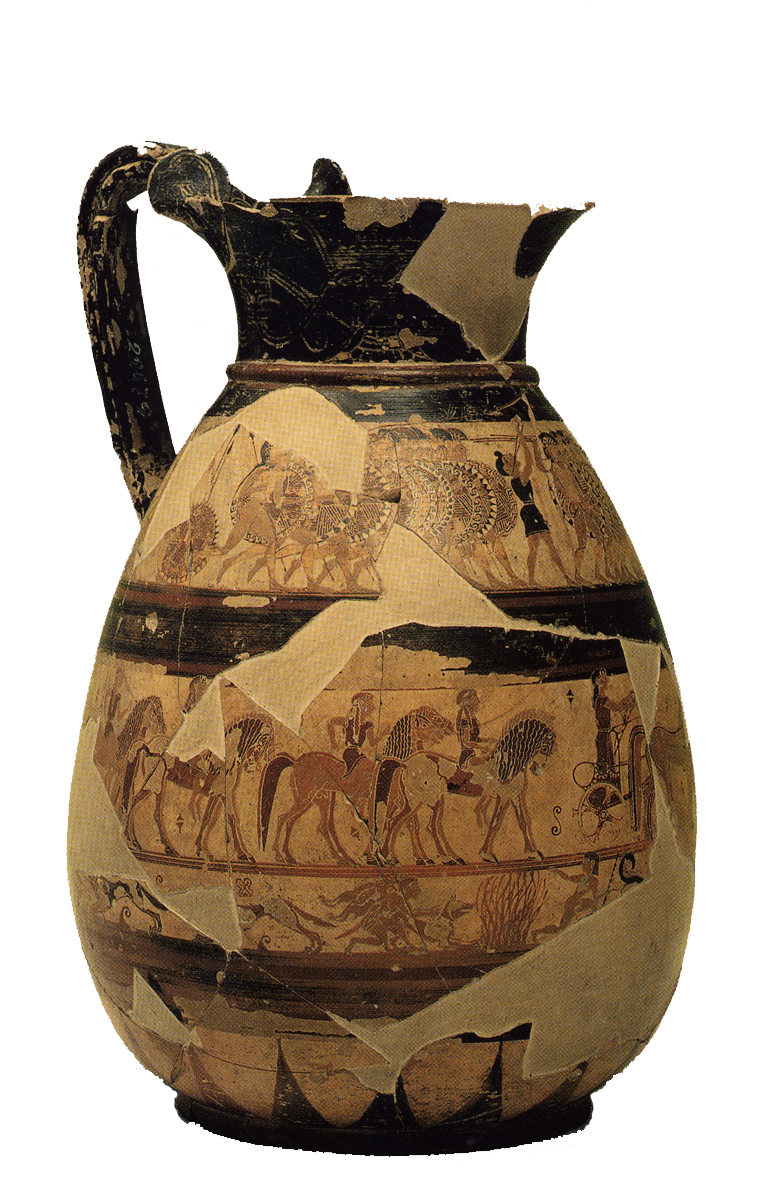
This brings this masterpiece to me as it were within reach and a visit to the Villa Giulia in the compulsory program for the next trip to Rome. In October of last year it was finally time. But then: when we came to the office of the Villa Giulia, a poster greeted us with the information that the crater of the Euphronios is currently on loan to Venice, the exhibition I Carabinieri per l'arte. Tessere di un patrimonio recuperato ... I could strangle the entire staff including the cleaning lady, but the good education was fortunately noticed in time, and we broke like two tickets. In fact, the visit was worthwhile even without Euphronios, at least in the recently revamped the first part. The organizing principle is there, the find context of the objects, the individual settlements and Etruscan necropolis. Nevertheless, the designers achieved a clear, understandable presentation of the epochs and styles, and I must admit that we could discover some masterpieces. Clearly difficult and strenuous was then the second, not yet updated part of the Villa Giulia, where to end in never ending space brimful glass cases in the sixties was followed by another dull design. And it culpable nonchalance, those responsible have done to hide the highlight of the house (at least for me) to be very efficient: In a small, dark side room were three cabinets as stored closely together in a few spots illuminated halbbatzig - and at the last moment, even when going out, I discovered in one of them Olpe Chigi , masterpiece of Corinthian vase painting and the time a regular in my archaeological lectures.
In these and similar experiences I am quite tempted to ask myself whether it really makes sense, a state of art returned, which treats its own resources so unkind. But as a Swiss one holds on this issue would be better to mouth. Nothing could illustrate this more appropriate than to the great Room adjacent to the store room above. There appear to be part of a new exhibition about art theft and art trade is built up, and already there are some gathered in recent years rediscovered objects of the highest quality. A particularly inglorious role played by the bonded warehouse Geneva - which I inevitably once again raises the question why the official Switzerland for decades, not only do nothing against the international art theft took, but it carried special laws even actively promoted. As much harm has been done, and there are no panaceas. One show after all, the fate of the Euphronios crater, but the current processes against the said Robert Hecht, the Getty curator Marion True : Awareness of the injustice increases.
Technicals: The Museo Nazionale Etrusco is located in the Villa Giulia , the former summer retreat of Pope Julius III. on the northern edge of the Villa Borghese. From the Piazza del Popolo ( Metro A , Flaminio) which is a pleasant walk, but you can also with bus 19 or tram (bus) 3 almost to the door. Only next time maybe I inquire in advance whether the object of my desire in the house ...


0 comments:
Post a Comment